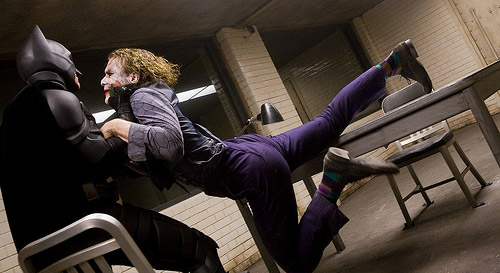
Batman and Joker: Enemies who need each other?
030626
Introduction
The hero and the villain are typically conceived as polar opposites: one upholds order, the other revels in chaos. Yet in
Christopher Nolan’s The Dark Knight, the Joker delivers a line that fundamentally unsettles this binary idea. During the film’s
iconic interrogation scene, he tells Batman: “I don’t wanna kill you. What would I do without you?”. This admission that the
villain’s existence is contingent upon the hero’s suggests a relationship far more complex than simple antagonism. Existing
scholarship has recognized this complexity — Şerbetçioğlu and Kurtyılmaz (2025) argue that Batman and Joker are “not just
adversaries but reflections of the same social contradictions,” a unity in which each character defines and sustains the other
(p. 1). Similarly, Rodriguez (2014) concludes that Batman and Joker could be “two sides of the same person,” bound by an
“intimate relationship” that transcends conventional notions of good and evil (p. 13). However, while these analyses establish
the symbolic and narrative interdependence of the two figures, they do not account for the psychological mechanism that
sustains this dynamic. This paper therefore asks: can codependency theory help explain the antagonistic relationship between
Batman and Joker in The Dark Knight? By analyzing key scenes in the film which feature direct or indirect confrontations between
Batman and Joker, we will demonstrate that the antagonism between Batman and Joker is atypical and operates as a psychologically
coherent dynamic of mutual dependence.
Framework of analysis
We begin by introducing the codependency framework used to interpret Batman and Joker’s relationship. Codependency is a
psychological phenomenon well-established in literature and describes a dysfunctional relationship dynamic. Individuals
in a codependent relationship usually possess an external focus and lack of clear self, deriving their identity from another
person and behaving like a “chameleon” (Bacon et al., 2018, p. 8). They exhibit compulsive self-sacrifice and interpersonal
control, choosing to neglect one’s own needs to dictate or “fix” the other, and believing that he is responsible for the
other’s needs (Marks et al., 2012, p. 2). Individuals deliberately suppress their emotions until they manifest in destructive
and violent ways. (Marks et al., 2012, p. 2.). The combination of these traits produces a relational imbalance oscillating
between extremes, manifesting the “seesaw” dynamic (Bacon et al., 2018 p. 9). The Batman-Joker relationship will be examined
through this lens in the ensuing paragraphs.
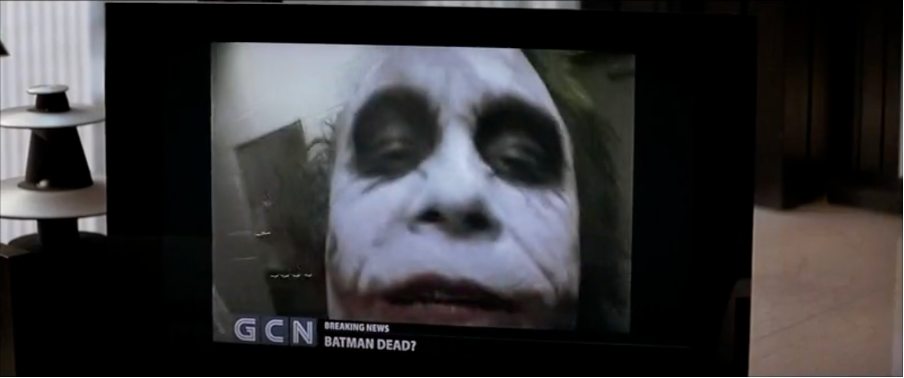
Fig 1: The Joker calls out Batman on television (Nolan, 2008, 43:20).
External focus and chameleon self
The dialogue and visuals in the film clearly depict how the Joker is fixated on Batman. During the interrogation scene,
Joker uses Batman to define his identity, admitting to Batman that “You complete me”. (Nolan, 2008, 1:28:17). This inference
is supported by Joker’s description as “non-duality in essence, all and no-thing” (Rodriguez, 2014, p. 13). Furthermore, he
is so focused on Batman that he desires the entire public to acknowledge his obsession. The Joker kidnaps people who dress
up as Batman, then tortures and ridicules them on live television to get the world, and particularly Batman’s attention. Just
as individuals in a codependent relationship behave like a “chameleon” and try to fit into the situation (Bacon et al., 2018,
p. 8), the Joker does not have his own purpose and can only derive fulfilment from knowing that Batman is focused on him.
Fortunately for the Joker, the obsession works: Batman aggressively corners mobsters to find out where the Joker is (Nolan,
2008, 1:05:45), only to realize that Joker is unreachable; the only path is for Batman to reveal his identity. Thus, we can
clearly observe that Batman and Joker develop this innate fixation on the other. The Joker’s admission reveals that his sense
of self depends entirely on Batman's existence; without him, he is "nothing". Batman, similarly, cannot fully inhabit his heroic
identity without the chaos the Joker represents; this accounts for why he actively responds to the Joker’s attention-seeking
antics. Our theory closely aligns with Şerbetçioğlu and Kurtyılmaz's (2025) doppelgänger hypothesis, which states that "each
character's narrative function presupposes the existence of the other" (p. 3).
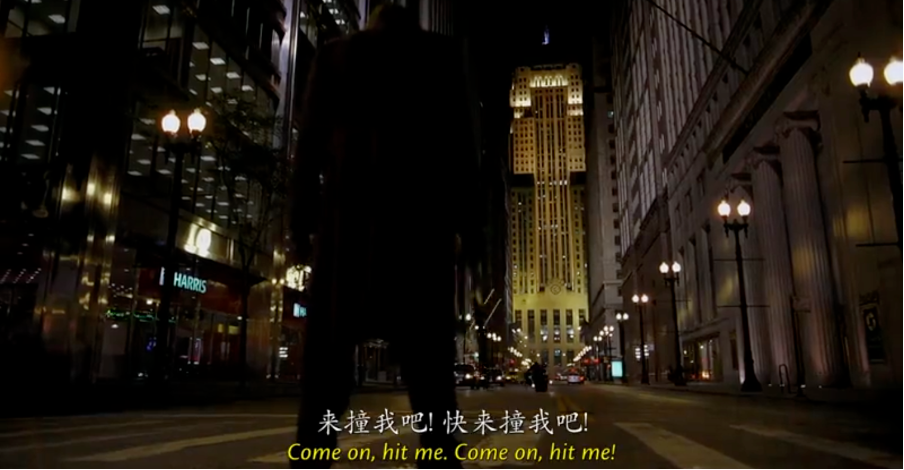
Fig 2: The Joker dares Batman to hit him (Nolan, 2008, 1:22:21).
Interpersonal control and compulsive self-sacrifice
The Joker has an overwhelming desire to control Batman’s actions. He constantly engineers moral dilemmas that force Batman to
make difficult decisions or even go against his own values. This is aptly illustrated in the scene where the Joker dares Batman
to hit him with his Batpod, because doing so would prove that even the most upright individuals can be corrupted. Batman ultimately
cannot bring himself to hit the Joker. The framing of the scene is especially significant as it is a wide angle shot with the Joker
in the foreground and Batman in the background. The two characters are standing along a straight path directly facing each other — a
direct visual representation of the entrenched belief in one’s capacity to fix other people’s problems and control their behavior
(Marks et al., 2012). The Joker wants Batman to do what he hates while Batman wants to subdue the Joker as well. Additionally, Batman’s
refusal to kill the Joker is framed as “ethical” heroism, but it also functions as a form of control; it is a rigid attempt to dictate
the terms of their conflict. Rodriguez (2014) supports this observation, noting that Batman “cannot kill the Joker because doing so
would destroy the very foundation of his own identity” (p. 12). Therefore, both Batman and Joker exhibit an intense desire to influence
and decide what the other does, which strongly supports the codependency theory.
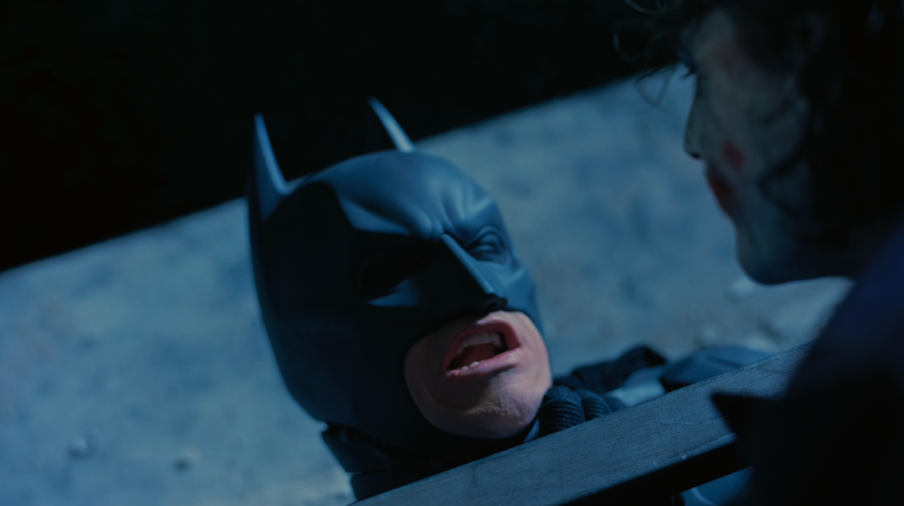
Fig 3: The Joker blows up Gotham General Hospital (Nolan, 2008, 1:52:12).
Emotional suppression and explosive expression
Both Batman and the Joker deliberately suppress their emotions, which then re-emerge in distorted and often violent forms.
Alfred describes the Joker as someone who “just wants to watch the world burn” (Nolan, 2008, 55:09), highlighting how the Joker
rejects conventional motivations such as wealth or power. Instead of expressing his impulses directly, he channels them into chaotic
and symbolic acts of destruction, such as burning large sums of money or blowing up a hospital. These actions are exaggerated expressions
of suppressed drives, redirected outward to provoke Batman. In contrast, Batman, quells emotions such as guilt, anger, and responsibility
to uphold his role as Gotham’s protector. This becomes evident when he chooses to turn himself in, stating that he has “enough blood on
[his] hands” (Nolan, 2008, 1:08:46). While being a strategic ploy, it is also driven by Batman’s effort to restrain his emotional burden
rather than confront it directly. Batman is overwhelmed with guilt and must prevent further harm caused by Joker’s actions. As previously
explained, individuals in codependent relationships suppress their emotions until they manifest in intense ways (Marks et al., 2012).
Similarly, both Batman and Joke pour their internal tensions into escalating external actions — the Joker through increasingly destructive
spectacles, and Batman through drastic decisions that intensify their conflict. Their behaviors do not indicate a lack of emotion, but
rather a pattern of suppression that ultimately fuels more extreme and unstable expressions, reinforcing the codependent nature of their
relationship.
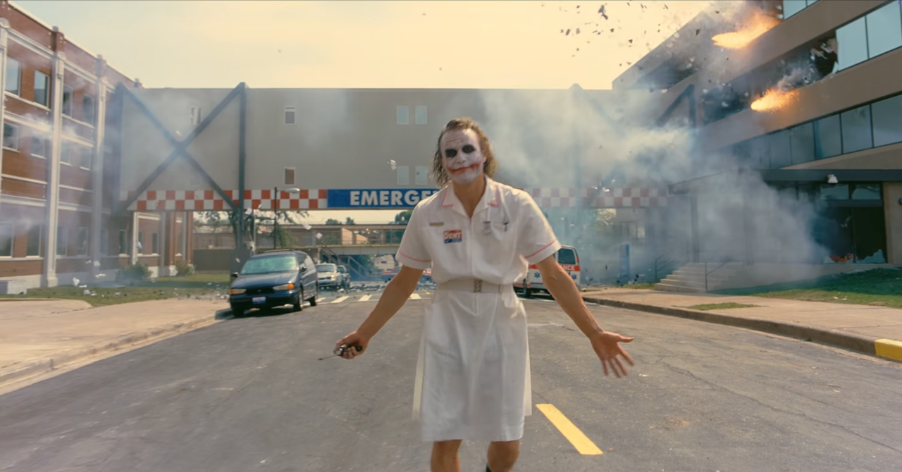
Fig 4: Batman and Joker fighting on the ledge (Nolan, 2008, 2:12:44).
Seesawing through extremes
The overall dynamic between Batman and Joker throughout the film is heavily characterized by an oscillation between extremes. On one end,
you have the interrogation scene where Batman and the Joker aim to dissect one another’s motives and ideology. On the other end, their
antagonism throughout the film culminates in a close-proximity physical struggle — the final fight scene where Batman and Joker are (literally)
locked in conflict. This scene captures their mutual dependence well because it pictures them face-to-face in a scuffle, as if their conflict
is eternal. Just as how Bacon et al. (2018) describes the seesaw effect as individuals feeling “out of control” unless locked in the dynamic
(p. 9), for Batman and Joker, equilibrium is impossible; they require extreme opposition to feel “alive”. When the Joker is subsequently
captured and is hanging upside-down from a rope, he thoughtfully remarks that “You and I are destined to do this forever.”, alluding to the fact
that Batman could not let the Joker fall to his death and chose to save him (Nolan, 2008, 2:13:30). Indeed, while the film is approaching its
end, Batman and Joker’s antagonism will continue perpetually. For both characters, as long the other exists, their lives have meaning.
Conclusion
The codependency framework illuminates the Batman-Joker relationship not as a simplistic opposition between good and evil, but as a
psychologically coherent dynamic characterized by external focus, compulsive control, suppressed emotion, and an extreme oscillating
relationship. It reveals why they cannot destroy each other, why they provoke rather than eliminate, and why their conflict is self-sustaining.
Henceforth, heroism is reframed from an individual quality to a relational one; it is magnified only in the presence of a complementary villain.
The Batman-Joker relationship teaches us that rivalry itself can function as a source of identity and motivation — both in fiction and in real life.
So, if codependency really describes the Batman-Joker relationship so suitably, then Joker’s remark in the interrogation scene may not just be a
taunt. In fact, it may describe their bond with incredible accuracy.